
Lee County Court Records After Arrest
After a Lee County jail arrest, three records may exist at the same time. The Three Forks jail roster shows custody and booking facts. The prosecutor's filing creates or shapes the charge record. The Kentucky Court of Justice docket shows scheduled court events for Lee County District or Circuit Court. These records can overlap, but they do not always match word for word because an arresting charge can be reviewed, amended, reduced, dismissed, or sent forward in a different form.
District Court handles misdemeanors, traffic, arraignments, and felony probable-cause hearings. Circuit Court handles felonies and capital offenses. The Lee County Courthouse page lists Circuit Court Clerk Tyler Phillips at 256 Main St., PO Box E, Beattyville, KY 41311, phone 606-464-8400. For custody and booking detail, use Lee County jail inmate records. For a booking photo tied to a current jail profile, use Lee County jail mugshots.
The Kentucky Court of Justice Lee County court page provides the official courthouse and circuit clerk contact context.
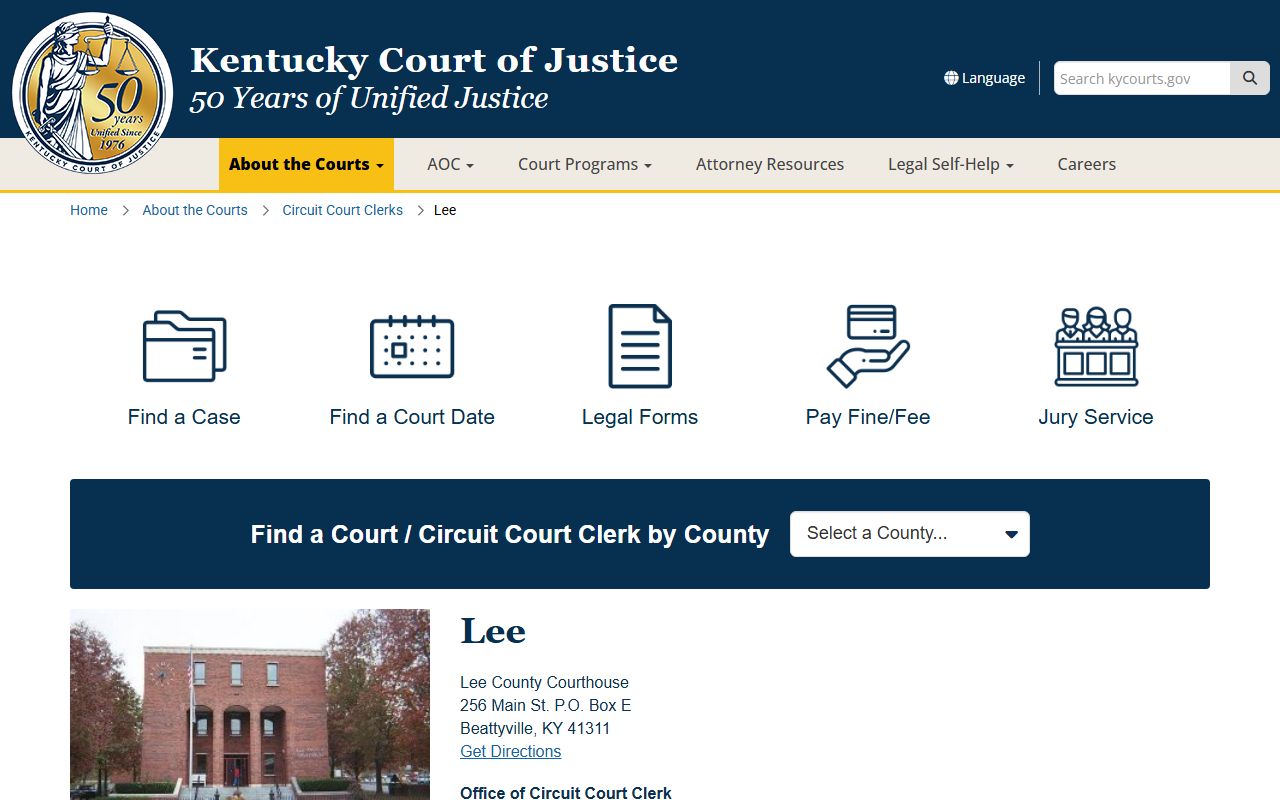
That clerk contact is the local fallback when the public docket does not answer a case-status question.
Find Court Records After Arrest
The public Kentucky Court of Justice docket search is built around county, division, date, courtroom, and subdivision. It is useful for hearing dates and docket settings after an arrest, but it is not the same as a complete certified court file. The docket page warns that information can change and may not reflect true case status at a given moment. For official copies, restricted access, or detailed file review, the Lee County Circuit Clerk or authorized KYeCourts access may be needed.
KYeCourts is a separate login system. It is not the same as the open public docket and should be treated as restricted access for users who have credentials. A person without authorized access should use the public docket, contact the Circuit Clerk, or request records through the proper court process.
- Select Lee County in the docket search. The inspected Lee option value was 0651.
- Choose District Court for misdemeanors, traffic, arraignments, and felony probable-cause hearings, or Circuit Court for felony cases.
- Enter the date to generate the docket, then narrow by courtroom or subdivision if those controls are available.
- Compare the docket result to the jail roster profile, because booking charges and filed court charges may differ.
- Call the Lee County Circuit Clerk when the public docket conflicts with a notice, bond order, or attorney information.
The KCOJ docket search controls show the date, county, division, courtroom, and subdivision fields used for Lee County court records after arrest.
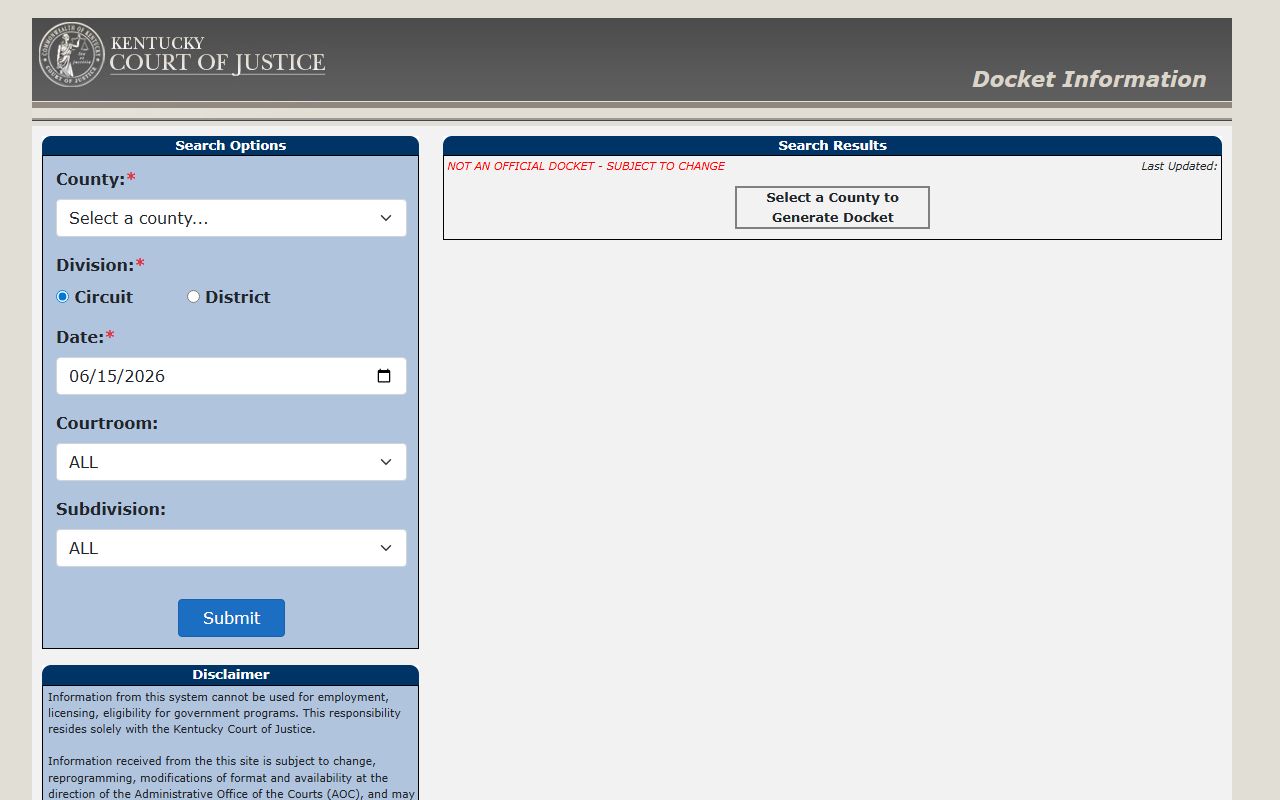
The search is event-focused, so it should be paired with the clerk record when a final disposition or certified charge history is needed.
| Field Label | Type | Required | Notes |
|---|---|---|---|
| County | Dropdown | Yes | Select Lee, inspected value 0651. |
| Division | Radio | Yes | Circuit or District, with Circuit checked by default. |
| Date | Date | Yes | Required docket date field. |
| Courtroom | Dropdown | No | ALL appears initially. |
| Subdivision | Dropdown | No | ALL appears initially. |
| Submit | Button | n/a | Generates the docket. |
Lee County Charging Documents
A jail arrest may start with an officer's allegation or warrant, but the court record depends on the charging document and the court level. Kentucky uses County Attorneys and Commonwealth's Attorneys, not a district attorney title. Lee County Attorney Thomas Hollon is listed locally in Beattyville. Felony prosecutions are handled by the Commonwealth's Attorney for the circuit that includes Lee County, and the Kentucky Commonwealth's Attorneys' Association lists Beverly Brewer for Estill, Lee, and Owsley.
This prosecutor split helps explain why the first jail profile, first District Court event, and later Circuit Court case may not use the same wording. A misdemeanor may stay in District Court. A felony may begin with an early probable-cause hearing, then move toward Circuit Court after indictment, information, or transfer. The docket should be read with that path in mind.
| Document | Who Uses It | What It Means After Arrest |
|---|---|---|
| Complaint | Officer or prosecutor | Starts or supports a criminal case, often at the first court stage. |
| Information | Prosecutor | Formal filed charges without a grand jury indictment where allowed. |
| Indictment | Grand jury | Formal felony charge path after grand jury action. |
Filed charges can be narrower or broader than the jail offense table. A roster row may list an arrest code, statute, charge description, court date, court type, court name, arresting agency, bond type, and bond amount. The court file is the stronger source for what the prosecution is actually pursuing.
Lee County Charge Status
Charge status is the part of court records after a jail arrest that most often changes. A charge can begin as pending, then be amended, reduced, dismissed, or resolved by plea or verdict. A nolle prosequi entry means the prosecutor is not proceeding on that charge at that time. It is not the same as a finding of innocence, and eligibility for expungement or record clearing depends on Kentucky law and the final case result.
| Status | What It Means |
|---|---|
| Pending | The charge is open and has not reached final disposition. |
| Amended or reduced | The filed charge changed, often after prosecutor review, plea talks, or court action. |
| Dismissed | The charge was ended by court order or prosecution action. |
| Nolle prosequi | The prosecutor declines to proceed on the charge at that time. |
| Convicted | A plea or verdict resulted in guilt on that charge. |
Bond After Lee County Arrest
No official Lee-specific bond-posting instruction page was found on the jail website. The practical route is to check the Three Forks profile for offense-level bond type and amount, check the KCOJ docket for the next Lee County court event, and call Three Forks Regional Jail for current release eligibility. Holds can prevent release even when a dollar amount appears. Common hold sources include parole or probation, another-county warrants, state DOC controlled-intake status, or a federal or immigration detainer.
| Bond Type | How It Works |
|---|---|
| Cash bond | Money is posted directly as security for release and court appearance. |
| Surety bond | A bonding company or surety backs the release under court-approved terms. |
| PR or own recognizance | The person signs a promise to appear rather than posting a full cash amount. |
| No-bond hold | No release amount is available until the court or holding agency changes the status. |
Note: A bond amount on the roster is not a promise of release if another hold, detainer, or court order is active.
Lee County Warrant Checks
No official active warrant search was located for Lee County, the sheriff page, Three Forks, or the court page. A jail profile can indirectly show that a person was booked on a warrant, and a court docket can show events tied to criminal cases, but neither is a complete active-warrant database. Bench warrants may arise from missed court dates and may not appear on a public sheriff list.
For active warrant confirmation, use the Lee County Sheriff at (606) 464-4120, Beattyville Police at (606) 464-5030 for city matters, and the Lee County Circuit Clerk at 606-464-8400 for court and docket questions. A person who thinks a warrant may exist should also consider legal counsel, because walk-in procedures, bond conditions, and surrender instructions depend on the issuing court or agency.
Charges and Convictions
An arrest and a charge are not convictions. Court records after a Lee County jail arrest may show an accusation before the government has proved the case. The final case result can be dismissal, amendment, plea, trial verdict, or another court disposition. That is why a docket or roster entry should not be described as a conviction unless the court record shows a conviction.
| Point | Charge | Conviction |
|---|---|---|
| Stage | Accusation after arrest or filing. | Final guilt result by plea or verdict. |
| Proof | Lower early-stage standard, often probable cause. | Beyond a reasonable doubt or admitted by plea. |
| Record meaning | Shows what was alleged or filed. | Shows the case ended in guilt on that count. |
Sealed and Expunged Records
Kentucky open records law gives public access to many records but also allows exemptions and redactions. KRS 431.076 covers expungement where charges are acquitted, dismissed, or do not result in indictment or information under stated conditions. The Kentucky State Police expungement certification process may also be part of clearing an eligible criminal record.
| Point | Sealed | Expunged |
|---|---|---|
| Public view | Hidden or restricted from routine public access. | Treated as cleared under the court order. |
| Access limits | Certain agencies or courts may retain limited access. | Access depends on the expungement statute and order. |
| Lee County route | Check with the court clerk or an attorney. | Follow the Kentucky expungement process for eligible cases. |
Restricted Lee County Court Records
Some court records after arrest may be restricted by law, court order, age, case type, or public-records exemptions. Juvenile matters, sealed cases, some domestic violence details, confidential identifiers, and records tied to ongoing investigations may not be available through the public docket. KYeCourts is separate from the public docket and requires a username and password for authorized users.
Public access also differs by record type. A docket entry can show that a case is set for a hearing, while a file-stamped order, complaint, indictment, or judgment may need clerk handling. Kentucky open records provisions support inspection of public records, but KRS 61.878 and other rules can limit disclosure of exempt parts of a record.
Important: Do not use docket, jail, or charge information for FCRA-covered screening; use a legally compliant background-check process.